
Project
To be changed is to be…
Change is the only certainty in life. We are transformed not only by time but also by those we meet, objects, spaces, and ideas.
Who and what do we become under the influence of others?
How do we affect each other?
Who are we to one another?
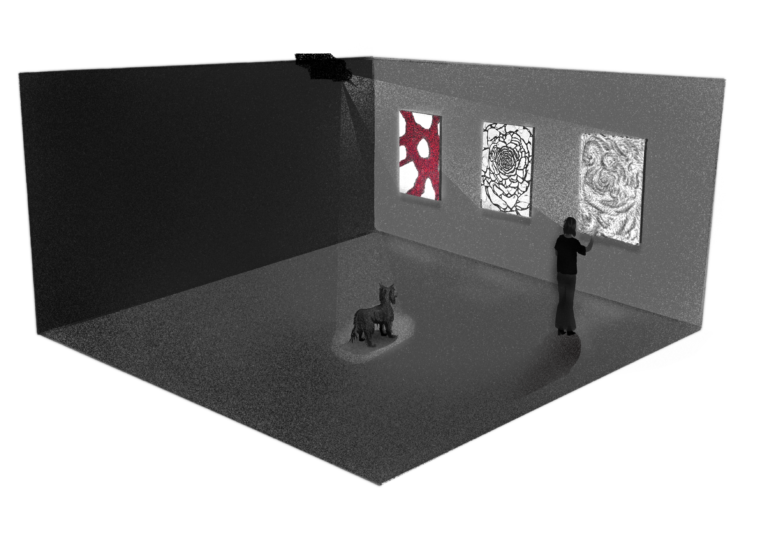
The presented exhibition consists of a triptych of reliefs and a dog sculpture, which are meant to tell a story about change. The viewer not only can look but also touch, stroke, comb, pull, hit, squeeze, and rub.
You can visit the exhibition in C5 “studio sztuki” on PJAIT’s campus in Warsaw, everyday between 12:00 and 18:00 from 27.01 to 22.02, 2025.
***
This project endeavours to explore the passage of time and its transformative impact on both individuals and their environments. Simultaneously, it aims to discern the specific attributes that captivate individuals towards particular stimuli. For instance, the hypothesis that pointed objects deter human touch will be examined through experimental testing. Through analysing participants’ interactions with an initial set of paintings, this research will discern preferences for shapes, textures, and colours conducive to tactile engagement.
The main goal of this thesis is to attempt to make time visible. Time is not the only variable in this experiment; human attachments and emotions must also be considered. They make it possible to measure interactions with an object by touch.
The genesis of this exhibition/experiment lies in a comparative image of two plushies and someone’s comment from Twitter/X. The first plushie was bought at the same time as the other. However, one was kept hidden in a closet while the other became a beloved toy for a child over many years. They may have been the same product when purchased, but their purpose differed. The plushie stored away in case the first one was lost or damaged remained unchanged, merely collecting dust. In contrast, the plushie that was constantly with the child– loved and embraced many times a day – underwent such significant changes in shape that it might be hard to recognise.
Human emotions and actions related to this toy made it something entirely different. On one hand, it became a worn-out toy that could be easily discarded. On the other, it turned into a symbol. Because it was loved, it served as a reminder of those feelings, a gateway to the past.
Objects
The first piece, initially titled ‘Coral reef/red’ and later renamed ‘(to be) Exploited,’ addresses the wear patterns of frequently handled objects and sculptures. Its coral reef appearance references the environmental impact of human overconsumption and everyday objects that wear down by interaction, which are easily replaceable. The red colouring is similar to fresh blood, designed to fade with human contact and potentially transfer to other pieces, creating an interconnected narrative. It is the first piece in a triptych, with its composition slightly moving from the centre to the upper right direction.
The second piece is “Glass/black”, “(to be) conquered”. It represents everyday objects made from fragile materials like glass, porcelain, etc. The objects might be valuable but are still replaceable. The middle piece in the triptych features a central upper composition resembling a rose with glass petals. I chose black to indicate the centre of the composition; it balances the red colour on its left against the white on its right and connects to the sculpture in the middle, which starts in black and gradually changes to white. Its composition is centred, slightly moved to the top. This piece had to be covered in foil for safety reasons, for when the glass would rip, it wouldn’t fall on the floor and become a safety hazard.
This piece represents all of the everyday soft objects, such as clothes, rugs, couches, and plush toys.
All of these objects are irreplaceable in appearance, but like previous pieces, memories cannot be replaced and must be bought as new copies.
It is based on a regular cotton canvas but requires customised edges with wooden panels constructed around it to create a box-like appearance. It’s the last object in the triptych. It has two layers, one material on the outside and another hidden underneath. Both have their composition moved from central to slightly upper left, with the hidden layer more noticeable. It contrasts the middle painting and the sculpture and mirrors the first object once it gets ripped to the second layer.
The dog sculpture stands alone without a duplicate, deliberately representing the irreplaceable nature of living beings and the inevitable process of aging and loss.
It was mostly inspired by bronze sculptures that turn gold after interaction like “canis felix”, a statue representing a dog, which after 20 years of being pet by people, had its head turned gold.
In this exposition, the sculpture represents every living being. The black fur is not fully attached to the white fur, making it easy to remove. The act of pulling out the fur symbolises the inevitable passage of time, specifically representing how quickly our loved ones age. The sculpture’s name derives from its treatment during the experiment, which is later described in the “Conducting the experiment” section. It is positioned in the middle of the triptych opposite the glass painting “(To be) conquered”, with both serving as bold black centrepieces. However, as the experiment progresses, this sculpture comes to more closely resemble the first and third paintings, becoming white with red elements, rather than the second.
Website
The website serves as both an advertisement for the exhibition and its documentation. The design embraces simplicity, featuring an off-white background. As with poster design principles, I limited the colour palette to three colours: black, red, and white.
The logo depicts hands forming an hourglass shape containing dropping blood within a loop. This symbolism represents how our actions are intrinsically linked with the passage of time—the hands representing our actions, and the dropping blood signifying the fleeting nature of the present.
The website was developed using WordPress with supplementary HTML and CSS code. Additionally I made 3 different cursors based on the upper part of the logo. The home screen’s layout progresses vertically from the centred logo and title to three horizontal subpages: “exposition”, “project”, and “about me”. Below these elements are three paintings arranged horizontally—red, black, and white—with a dog sculpture positioned centrally. This arrangement mirrors the physical exhibition layout. The dog faces the middle painting, requiring viewers to turn away from the central painting to view its face.
Throughout the experiment, I photographed the paintings daily for website documentation. These images transition with a fade effect when clicked, displaying their evolution. Selecting the dog sculpture directs visitors to a subpage featuring the text “As you spin, time passes” in light grey, encouraging interaction. The interactive spinning feature reveals the dog’s transformation from black to white fur. This effect required eight photographs from different angles across five construction stages, creating a three-dimensional appearance that represents the ageing process anticipated in the physical exhibition.
Five-day experiment
Day One
On the first day of the Object/Body workshop, I introduced students to the exhibition concept and established the interaction guidelines: tactile exploration was encouraged using hands only, and while the dog installation could be interacted with in various ways, its position was to remain fixed.
The students showed immediate interest in the sculpture, though they initially sought confirmation regarding permission to engage in physical interaction. They inquired about the sculpture’s origins, specifically whether it was an original creation or an acquisition. During the break, approximately five students remained engaged with the installations. Their initial hesitation was evident as they observed each other, seeking mutual validation before proceeding with tactile exploration.
Most participants followed a systematic approach, engaging with the pieces sequentially from left to right, concluding with the dog installation. One participant, however, deviated from this pattern, approaching the dog installation directly. Their interaction progressed from visual observation to a crouching position, culminating in tactile engagement. Subsequent interactions with the installation were notably more tentative.
Day two
Instruction on interacting with the exposition was hung next to the pieces. It read:
“TO BE CHANGED IS TO BE… The presented exhibition consists of a triptych of reliefs and a dog sculpture, which are meant to tell a story about change. The viewer can not only look but also touch, stroke, comb, pull, hit, squeeze, and rub the objects. Every interaction represents a feeling. So… What feelings do YOU want to show? Scan me to become the change! tobechanged.eu”.
On the second day, there was a difference to be noticed in the state of the artworks. There was a clearance on the first piece. It meant some people must have touched it, although it was still very light and restrained contact. The second piece was left with a red print in the middle. The third piece showed a few holes in the woollen fabric, and the thread had been pulled.
The sculpture of a dog lost some black fur from petting, mainly in the head area, including its ears, but also near its paws.
Students showed a clear interaction pattern, primarily touching the first and last paintings while avoiding the middle ones. An incident occurred when one student directly slapped the glass painting and got hurt, suggesting there should be a warning about its sharp edges. When asked if they did not expect broken glass to be sharp, they admitted they weren’t sure it was real glass.
Participants treated the dog sculpture with care and respect, mostly hugging and gently petting it. Whenever their interactions caused fur to fall off, they carefully placed it back where it came from, showing concern for the artwork’s appearance.
Day three
There was a significant difference between the first two days and the third day. The first piece was visibly punched, displaying few holes and being stuffed with black fur from the dog sculpture. Many hand markings appeared, a smiling face in the centre and the word “help” on top. The second piece was covered in plastic for safety precautions, but on the third day, the plastic was torn, and surprisingly, this exposed part of the glass was being touched the most. The thread from the third piece was connected with the second one by hooking it on a shard of glass.
In the third piece, significant holes appeared, and many pieces of black fur were stuck between them.
The sculpture lost most of the black fur from its head, and the white fur underneath it had red marks from the first piece.
Even though the students were informed that they could only use their hands, they used various materials to interact with objects, such as scissors or knives.
Day four
The first piece was punctured, and holes filled with the black fur of the dog’s sculpture. There was also a heart symbol and a penis shape, plus a new smiling face next to “help”. Threads from the third piece were connected with the second and first, creating a variation of a spider’s web. More red hand prints appeared on the second piece. The third one was riddled with holes.
The dog became almost white, with red markings in the middle and black fur stacked on top of it. It was also tied by the head and tail with a thread from the wool piece.
Day five
On the fifth and final day of the workshop, notable changes could have been observed across all pieces. The first painting showed increased wear, with visible fur loss due to gravity and participant interaction. The fabric tension had decreased, connecting all of them, and new red hand impressions appeared, with some glass fragments embedded in the main structure.
The middle painting showed minimal changes, with only a few minor tears in its plastic covering. The final painting exhibited more extensive modifications, including a newly formed knot in its centre, a smiling face created in the top left section and new holes filled with black fur.
The dog sculpture underwent the most significant transformation. It was freed from its restraining rope and displayed an almost completely white surface due to the loss of its black fur covering.
Outcome
The five-day experiment demonstrated a visible evolution in how participants interacted with the exhibition pieces, progressing from hesitation to bold engagement. While the first day was characterized by cautious approaches and requests for permission, upcoming days showed increasingly confident and creative interactions with the artworks. Students noticed the connection between all of the pieces and decided to connect them visually by using the outer layer of the third piece, so it became like a neural net pattern from the brain.
The first piece evolved from showing minimal contact marks to acquiring multiple punctures, stuffed with black dog fur, and various markings including text and drawings.
The second piece, despite its glass composition and protective covering, accumulated torn plastic and red handprints, additionally filled with black fur in the opening.
The third piece progressed from minor wool pulling to extensive hole creation, with pieces cut away and its threads eventually connecting all four pieces in a spider-like web pattern.
The dog sculpture underwent the most dramatic transformation, changing from black to almost completely white with red markings through fur loss, with participants initially attempting to preserve fallen fur before beginning to intentionally redistribute it across all other pieces. This evolution from preservation to creative repurposing exemplifies the broader shift in participant behavior.
Notably, participants eventually transcended the original “hands only” guidelines, introducing tools and creating unexpected connections between pieces. This progression from hesitant touching to bold modification demonstrates how repeated exposure and permission to interact can transform viewer relationships with art from passive observation to active co-creation, successfully fulfilling the workshop’s objective of emphasizing tactile experiences in art perception.
Conclusion
The actions of people taking part in the exhibition in person gradually intensified. At first, almost no one wanted to interact with the pieces. In time, people became more active and started to disrupt the artworks. The actions of people treating the pieces gently became impossible to notice because of the chaos that ensued. The survey revealed that the audience had various reactions and reflections.
Before this project, I had predictions about how the pieces would change through time and interaction; during presentations, I would show visualisations of what I believed might happen. Even though I maintained these hypotheses, I knew how unpredictable this change might be. All the objects were designed to unveil something new when interacted with, but nothing could have prepared me for what I saw on the experiment’s third day when everything changed drastically. Although I was pleased with the fact that there was an interaction that they had changed, something hurt me deeply—the fact that I had worked on them so hard only for them to be altered to the point of destruction. They were not unrecognisable but different, no longer something I knew.
The most challenging piece to witness was the sculpture representing the dog. It was meant to represent a living being, so there was a particular assumption that it would be treated respectfully, but it was not. It was tied up by the neck and tail, which are delicate and essential parts of an animal’s body. It exemplifies the destructive part of human beings. I had decided early on that I would not participate in touching the objects, as I knew what I wanted to happen to them. I wanted to study others’ reactions, but at this point, it became difficult not to intervene as I tried to free the sculpture from its torture quickly.
According to the survey, the audience connected everything in a poetic way despite the exhibition’s disruption. This may be a result of all the objects that were connected with pieces of each other, whether it was red paint, glass, thread, or black fur. Instead of four objects, they became one in some sense.
Of course, there were some people who were exceptions and interacted differently from the majority—one person, as soon as she saw the dog in trouble, grabbed scissors quickly and cut away all of the pieces, keeping this piece prisoner.
In summary, this exhibition exemplified the differences in people’s approach to inanimate objects and different textures.
Developed by Sonia Herman
Master’s Project in Graphic Design and Multimedia Art
New Media Art
PJAIT, 2025
Supervised by tutor team:
Art/Main tutor: dr Anna Eichler
Thesis tutor: dr Jakub Karpoluk
IT tutor: mgr inż. Minh Hai Duong
Być zmienionym, znaczy być…
Zmiana jest jedyną pewną w życiu. Odmienia nas nie tylko czas, ale zmieniają nas ci, których spotykamy, przedmioty, przestrzenie, idee.
Kim, czym się stajemy pod wpływem innych?
Jak wzajemnie na siebie działamy?
Kim dla siebie jesteśmy?
Prezentowana wystawa składa się z tryptyku płaskorzeźb oraz rzeźby psa, które mają o zmianie opowiedzieć. Widz może nie tylko patrzeć, ale również dotykać, głaskać, czesać, wyciągać, uderzać, gnieść, pocierać.
Wystawę można odwiedzić w sali C5 “studio sztuki” na kampusie PJATK w Warszawie,
codziennie między 12:00 a 18:00.
Projekt wykonany przez: Sonia Herman
Praca magisterska na kierunku Projektowanie Graficzne i Sztuka Multimediów
Sztuka Nowych Mediów
PJATK, 2025
Pod opieką składu promotorskiego:
Promotor główny: dr Anna Eichler
Promotor pracy pisemnej: dr Jakub Karpoluk
Promotor techniczny: mgr inż. Minh Hai Duong